You don't need another AI tool. You need the right patent tool.

Download the AI Patent Tool Comparison guide to see how five patent tools compare across the categories that matter most to prosecution outcomes.

AI Patent Tool Comparison guide

Built for patent teams who need AI tools equipped for prosecution work

  • Lewis Rice
  • oblon+-+new
  • Sughrue
  • Dentons
  • Lee+and+Hayes-1
  • LG Energy Solution
  • Kyocera
  • Shell
  • TSMC

The issue is not whether a tool has AI. The issue is whether your team can trust what it produces.

Patent teams do not reject AI because they are resistant to change. They reject AI when the output feels too generic, too hard to verify, or too disconnected from the data and workflow context required for real patent work. That is where hallucination risk becomes an adoption problem, and where “AI-enabled” stops being a compelling buying criterion.

This is why the better evaluation question is more practical and more demanding. Is the tool built on data your team can trust, and does it produce outputs that feel usable inside real prosecution workflows? If the answer is unclear, the team will hesitate no matter how polished the demo looks.


Lawyer frustrated with AI patent tool

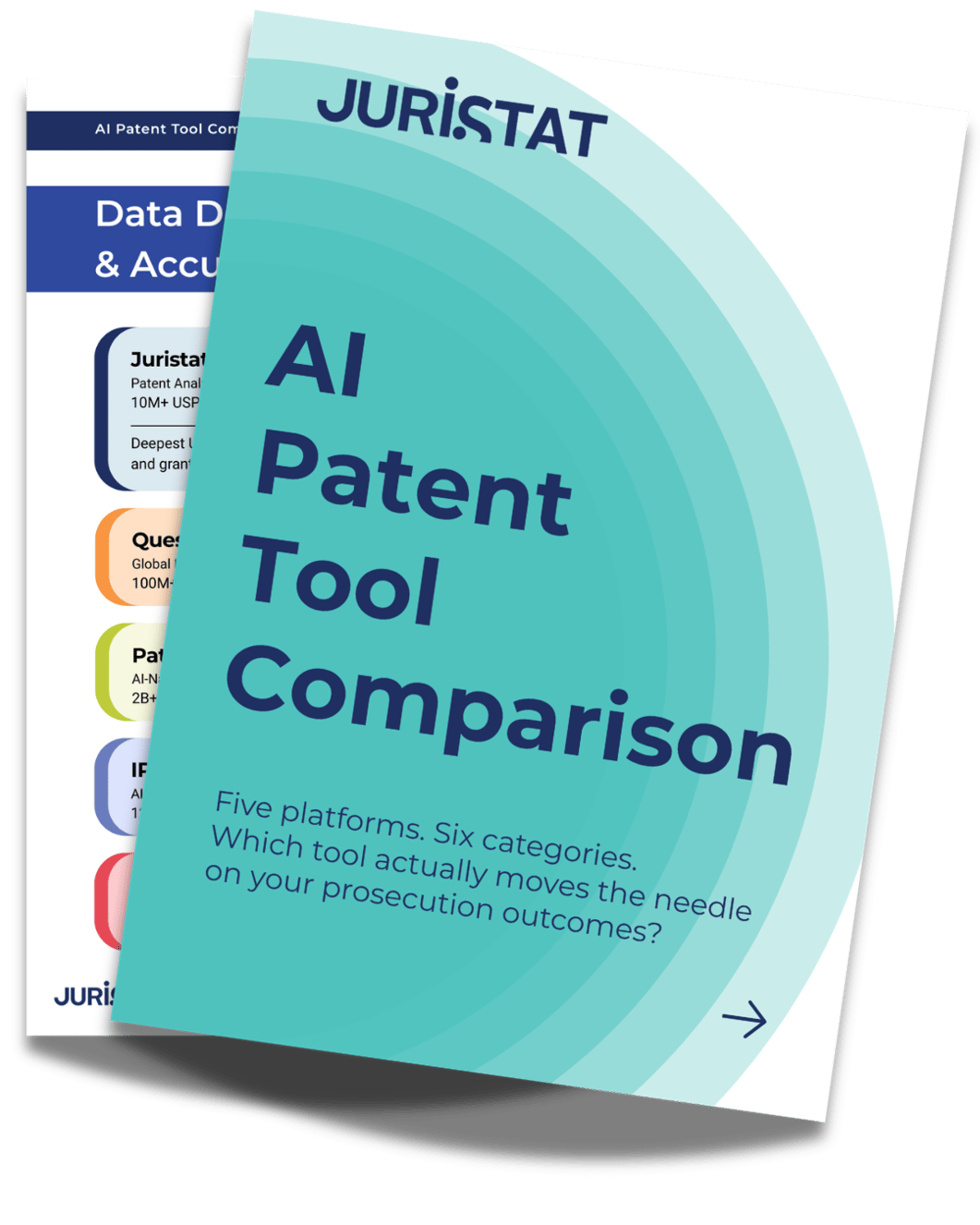
AI Patent Tool Comparison Guide

AI Patent Tool Comparison Cover mock up

A smarter way to compare what sits behind the AI

This guide is designed to help patent teams evaluate AI tools with more discipline and less guesswork. It compares Juristat, Questel Orbit, PatSnap, Patlytics, and IPRally across overall score, AI capabilities, data depth and accuracy, security and compliance, prosecution intelligence, and market adoption and trust.

Download now for a cleaner way to compare those foundations, not just the surface-level features.

AI Patent Tool Comparison Cover with person mock up

Built to show the differences that actually matter

This is not a generic vendor roundup. The guide is organized around the categories that affect whether a patent team will rely on a tool in practice, and it includes a sources and methodology section that explains how the comparison was built from publicly available vendor materials, certifications, and feature comparisons verified in April 2026.

That structure makes the asset more credible and more actionable. Instead of forcing readers to infer what matters, it gives them a clear scoring framework and category breakdowns they can use to evaluate tools with sharper judgment.

“[With Juristat] we gain easy and reliable access to valuable insights on patent trends and competitor activity and gain additional support for making informed decisions.”

– Patent Professional at a Top Patent Firm

Better patent AI decisions start with better data

Instead of relying on generic, surface-level claims, teams can plug Juristat's industry-leading data into their existing workflow. 

When data is defensible, the workflow fits patent practice the output is strong enough to earn the trust of your team and clients. Juristat customers use that approach to:

  • Win and retain Fortune 500 clients
  • Negotiate from a data-backed position in outside counsel reviews
  • Show differentiated performance at the tech center, art unit, or examiner level
  • Improve internal operations and practice group efficiency
  • Outperform the USPTO average allowance rate by 10+ percentage points

This guide is built to help patent teams compare AI tools with more rigor and identify which solutions are most likely to support real prosecution success.

Download the AI Patent Tool Comparison guide

See how five AI-forward patent platforms compare, and whether your current legal tech stack is built for trusted, high-value use in patent work.

Want a sharper read on the AI patent tools
your team is using now?

Schedule an AI tool analysis with Juristat’s IP Solutions team. We’ll help you compare your current stack against the criteria that matter most in patent work, including data trust, output reliability, workflow fit, and whether the product is likely to earn real attorney usage.